
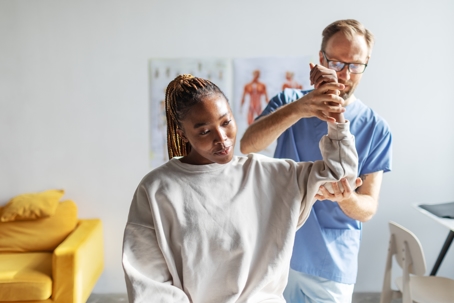
When elbow pain doesn’t go away, this an be frustrating. By the time someone reaches this stage, they’ve often tried different remedies such as rest, medication, bracing… maybe even injections or surgery. And yet, something still feels “off”.
You may have lingering stiffness, occasional flare-ups, weakness or instability or fear of reinjury. This is where physical therapy becomes not just helpful—but essential.
Because at this level, recovery is no longer just about healing tissue.
It’s about restoring confidence, function, and durability for the long term.
When Surgery Enters the Picture
While most elbow conditions can be treated conservatively, some cases require surgery.
Common Elbow Surgeries:
- Tendon repair (for severe tendon damage)
- UCL reconstruction (common in throwing athletes)
- Nerve decompression or transposition
- Removal of damaged tissue (debridement)
But here’s the critical truth: Surgery fixes structure. Physical therapy restores function.
Without proper rehab, even a technically successful surgery can lead to stiffness, weakness, compensatory movement patterns, or reinjury.
Rehabilitation after elbow surgery is highly structured and progresses in stages.
Phase 1: Protection & Early Healing (Weeks 0–2/4)
Goals:
- Protect surgical repair
- Control pain and swelling
- Begin gentle movement
What PT Focuses On:
- Passive or assisted range of motion
- Pain management strategies
- Education on safe movement
At this stage, doing too much is just as harmful as doing too little.
Phase 2: Mobility & Early Activation (Weeks 3–6)
Goals:
- Restore range of motion
- Prevent stiffness
- Begin light muscle activation
PT Interventions:
- Gentle stretching
- Isometric exercises
- Joint mobilization
Patients often start to feel better here—but the tissue is still healing.
Phase 3: Strength & Control (Weeks 6–12)
Goals:
- Build strength
- Improve stability
- Restore basic function
PT Focus:
- Progressive resistance training
- Functional movement patterns
- Coordination exercises
This is where the foundation for long-term success is built.
Phase 4: Return to Activity (3–6+ Months)
Goals:
- Return to work or sport
- Prevent reinjury
- Restore confidence
PT Includes:
- Sport-specific or job-specific training
- Load progression
- Movement retraining
For athletes, this phase is especially detailed and gradual.
Chronic Elbow Pain — Why It Lingers
Chronic pain is often misunderstood. If your elbow still hurts months later, it doesn’t always mean that something is “torn”, or that healing failed. Instead, chronic pain is often due to:
1. Incomplete Rehabilitation
- Strength wasn’t fully restored
- Movement patterns weren’t corrected
2. Nervous System Sensitization
- The brain becomes more sensitive to pain signals
- Even normal movement can feel uncomfortable
3. Fear of Movement
- Avoidance leads to stiffness and weakness
- The joint becomes less resilient
4. Repeated Micro-Irritation
- Poor habits continue (ergonomics, technique, posture)
Chronic cases require a more holistic and progressive approach.
Instead of complete rest or overuse, PT helps patients with chronic elbow pain find the “middle ground”, i..e what can you do safely? How much is too much? How do you progress? This balance is key to breaking the pain cycle.
Even painful tendons and joints can improve with the right loading strategy. Programs often include isometrics → eccentrics → full movement, gradual resistance increases, and functional strengthening.
Understanding pain reduces fear—and fear reduction improves outcomes. Patients learn:
- Pain ≠ damage
- Some discomfort is safe
- Movement is part of healing
Physical therapists identify and correct inefficient lifting patterns, poor posture, and overuse of certain muscle groups.
For nerve-related or persistent pain, we take a gradual exposure to movement, apply nerve gliding (if appropriate), and incorporate relaxation and breathing strategies.
The Role of Consistency in Long-Term Recovery
One of the biggest predictors of success is simple: Consistency over intensity. This means doing the right exercises, which can be a few times per week and lasting over several months. This is far more effective than sporadic, high-intensity effort.
Once pain is gone, the goal shifts to resilience. Key component include:
1. Strength Maintenance
- Regular forearm strengthening
- Grip training
- Shoulder and upper back exercises
2. Mobility Work
- Stretching forearms
- Maintaining joint range of motion
3. Load Awareness
- Gradually increasing intensity
- Avoiding sudden spikes in activity
4. Technique Optimization
- Proper lifting form
- Efficient sports mechanics
5. Recovery Habits
- Rest when needed
- Manage workload
- Address early warning signs
Even after recovery, certain symptoms should be evaluated such as persistent or worsening pain, numbness or tingling, significant weakness, or loss of function. Catching issues early prevents long-term setbacks.
The Future of Physical Therapy for Elbow Conditions
Physical therapy continues to evolve with a better understanding of tendon loading, improved rehab protocols and integration of technology (movement tracking, tele-rehab). However, the core principle remains the same: Movement is medicine—when applied correctly.
Elbow pain is rarely just about the elbow. It’s about how you move, how you load your body, how you recover and how consistent you are.
Physical therapy works because it addresses all of these layers—not just the symptoms.
You don’t need to stop using your elbow. You need to learn how to use it better.
And that’s exactly what physical therapy is designed to teach. Our physical therapists at Lifestyle Physical Therapy are here to help. Contact us today!