
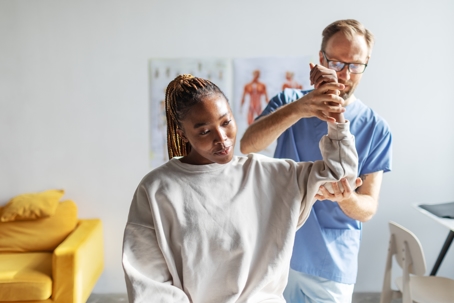
The elbow is one of the most underappreciated joints in the human body—until something goes wrong.
Whether you're lifting groceries, typing at a desk, throwing a baseball, or pushing yourself up from a chair, your elbow is constantly at work. Despite this, many people don’t think about elbow health until they experience pain, stiffness, or limited mobility.
When that happens, the instinct is often to rest, take pain medication, or in severe cases, consider surgery. But there’s a highly effective, often underutilized solution that sits right in the middle: Physical therapy.
Physical therapy plays a critical role in not only healing elbow injuries, but also in restoring strength, preventing recurrence, and improving long-term joint health.
Anatomy of the Elbow
To understand how physical therapy helps, we first need to understand what we’re working with.
The elbow is not just a simple hinge—it’s a complex joint made up of three bones: Humerus (upper arm bone), Ulna (inner forearm bone), Radius (outer forearm bone).
These bones form three joints in one: Humeroulnar joint – allows bending and straightening, Humeroradial joint – assists in movement and load-bearing, Proximal radioulnar joint – allows rotation (turning your palm up/down).
The elbow is stabilized and powered by several key structures:
Ligaments:
- Provide stability
- Prevent excessive movement
- Example: UCL (important in throwing athletes)
Tendons
- Connect muscles to bones
- Common injury sites (e.g., tendonitis)
Muscles
- Flexors (bend the elbow)
- Extensors (straighten the elbow)
- Rotators (turn the forearm)
Nerves
- The ulnar nerve (funny bone) is especially vulnerable
- Can cause tingling, numbness, or weakness
Why Elbow Injuries Are So Common
The elbow sits at the intersection of the shoulder and wrist, meaning it absorbs stress from both directions. Here are some common causes of elbow problems:
1. Repetitive Motion i.e. typing, tennis or golf swings, assembly line work
2. Overuse i.e. lifting weights improperly, or sudden increase in activity
3. Poor Mechanics i.e. bad posture, or improper sports technique
4. Trauma i.e. falls, direct blows
5. Age-Related Degeneration i.e. tendons lose elasticity, or joint surfaces wear down
What Is Physical Therapy, Really?
Physical therapy is often misunderstood as just “exercises.”
In reality, it’s a comprehensive, science-based approach to restoring movement and function.
Our physical therapists at Lifestyle Physical therapy evaluate:
- Movement patterns
- Muscle imbalances
- Joint mobility
- Pain triggers
- Functional limitations
From there, we create a customized treatment plan.
Why Rest Alone Isn’t Enough
One of the biggest mistakes people make is relying solely on rest. While rest can reduce symptoms temporarily, it doesn’t address weak muscles, poor mechanics, or tissue resilience. This is why pain often returns once activity resumes.
Physical therapy fills that gap by rebuilding strength, improving tissue tolerance, and teaching proper movement.
Pain isn’t just physical—it’s also neurological. Physical therapy helps by gradually reintroducing movement, reducing fear of pain, building confidence in the joint. This is especially important for chronic elbow conditions.
The Healing Timeline (And Where PT Fits In)
Healing isn’t linear—it happens in stages. Physical therapy adapts to each phase.
Phase 1: Acute (Inflammation)
- Focus: pain control, protection
- PT approach: gentle movement, avoid aggravation
Phase 2: Subacute (Repair)
- Focus: tissue healing
- PT approach: light strengthening, mobility work
Phase 3: Remodeling (Recovery)
- Focus: restoring full function
- PT approach: progressive strengthening, return-to-activity training
Your first PT visit typically includes:
1. Evaluation
- Medical history
- Movement assessment
- Pain mapping
2. Diagnosis & Plan
- Identification of root cause
- Customized program
3. Initial Treatment
- Hands-on therapy
- Introductory exercises
4. Education
- What to avoid
- What to start doing immediately
Physical therapy isn’t just about reducing pain—it’s about fixing the root cause.
We aim to reduce pain and inflammation through manual therapy, ice/heat protocols, and activity modification. We aim to restore your range of motion through gentle stretching and joint mobilization techniques. We aim to improve strength through targeted exercises and progressive resistance training. We aim to correct movement patterns through posture training and ergonomic adjustments. Lastly, we aim to prevent recurrence through education and long-term exercise plans.
Who Benefits Most from Physical Therapy?
Almost everyone with elbow pain benefits from physical therapy. Whether you work in an office or do a lot of hands on manual labor with repetitive strain, play sports (such as tennis, baseball or golf), or are an older adult with joint stiffness — physical therapy can fix the root cause and reduce pain.
Elbow injuries can feel limiting, frustrating, and slow to heal. But they don’t have to be. Physical therapy offers a path that is non-invasive, evidence-based, and focuses on long-term results.
Contact us at Lifestyle Physical Therapy today to get started!